


ADA Signage Requirements in Massachusetts: 2026 Complete Compliance Guide
For nearly all Massachusetts developers, business owners, and property managers, ensuring full compliance with ADA signage requirements is a legal and ethical necessity. Non-compliance is not just a legal risk that can lead to significant fines; it is a barrier to accessibility that excludes individuals with disabilities from your facility. This guide provides a comprehensive overview of federal and state ADA signage requirements to help you ensure your property is welcoming and accessible to everyone.
Key Takeaways:
• Compliance is Mandatory: for nearly everyone: Both federal ADA standards and Massachusetts-specific regulations (521 CMR) must be followed for all public accommodations. Private clubs are generally exempt from both ADA and 521 CMR compliance. Religious organizations are generally exempt from ADA compliance but not from 521 CMR compliance
• Focus on Key Areas: Permanent room signs, directional signs, and parking signs have specific requirements for tactile characters, Braille, mounting height, and color contrast.
• Avoid Common Violations: Incorrect mounting height, missing Braille, and insufficient color contrast are the most frequent and easily avoidable compliance issues. Note that even a single instance of failed compliance could result in the refusal to grant a certificate of occupancy or could result in fines.
• Expert Partnership is Key: Working with a signage expert is the most reliable way to guarantee full compliance and avoid costly mistakes.
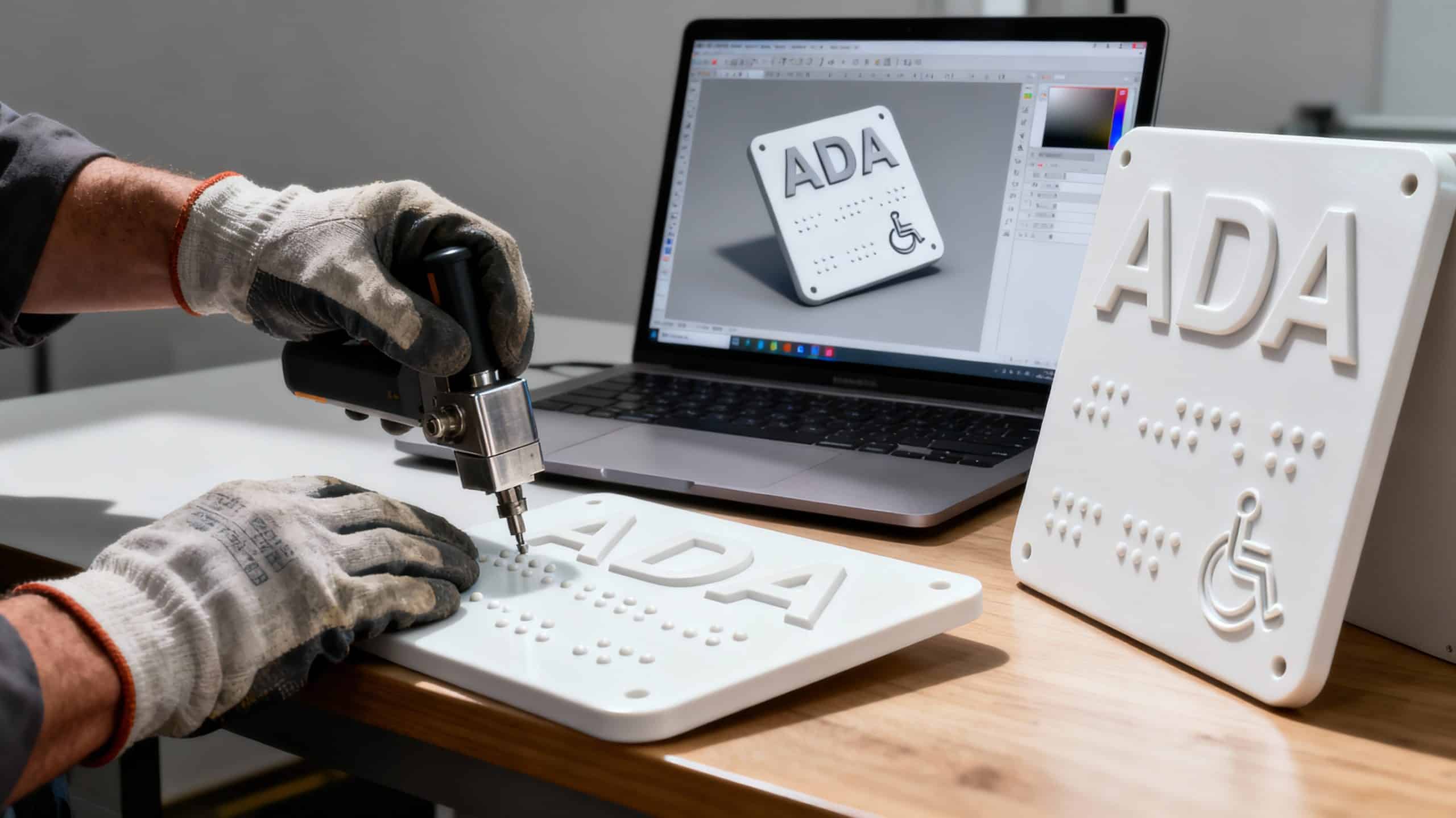
Understanding ADA Signage Requirements
ADA-compliant signage refers to a set of standards that ensure signs are readable and accessible to all individuals, including those with visual or mobility impairments. In Massachusetts, compliance involves adhering to both the federal ADA Standards for Accessible Design and the state-specific Massachusetts Architectural Access Board (AAB) regulations (521 CMR). These rules apply to a wide range of public accommodations, including commercial office buildings, healthcare facilities, retail stores, and multifamily housing developments.
The Technical Details of Permanent Room Identification Signs
Permanent room signs, such as those identifying restrooms, conference rooms, and office suites, have the most stringent requirements. These signs must be designed to be readable by both sight and touch.
Key technical specifications include:
• Tactile Characters: All letters and numbers must be raised by 1/32 inch and be in a sans-serif font.
• Grade 2 Braille: Braille must be located directly below the corresponding tactile text.
• Mounting Height and Location: Signs must be mounted on the latch side of the door, with the baseline of the tactile characters between 48 and 60 inches from the finished floor. (mounting height requirements for signs sometimes conflict, making it impossible to comply with both the federal requirements and Massachusetts requirements simultaneously in some cases. The Massachusetts Architectural Access Board (MAAB) released an advisory opinion in 2021 stating that in such cases the ADA signage mounting requirement provides equal or greater access compared to the 521 CMR requirement and so the height requirement of the ADA should prevail without the need to seek a variance to 521 CMR).
• Finish and Contrast: The sign must have a non-glare finish, and the characters must have a high contrast with the background (a 70% light/dark difference).
Directional and Informational Signage
While directional and informational signs (such as wayfinding signs and overhead directories) do not require tactile characters or Braille, they still have specific rules to ensure readability for individuals with low vision. These requirements focus on visual characteristics:
• Character Proportions and Height: Letters must have a specific stroke width and height based on the viewing distance.
• Finish and Contrast: Like permanent room signs, these signs must have a non-glare finish and high contrast.
• Use of Pictograms: The International Symbol of Accessibility ♿ and other standard pictograms must be used where required.
Common ADA Signage Violations and How to Avoid Them
Many facilities fall out of compliance due to a few common, easily avoidable mistakes. Conducting a basic audit of your facility can help you identify and correct these issues before they become a legal problem.
| Common Violation | How to Avoid It |
| Installing signage without required permits | Verify local permitting requirements early and obtain approval before fabrication or installation |
| Improper sign placement that obstructs walkways or entrances | Review site plans during the planning phase to ensure required clearances and paths of travel are maintained |
| Non-compliant ADA signage (incorrectheight, spacing, or tactile elements) | Follow ADA guidelines carefully and confirm all measurements and specifications prior to installation. Jigs and positioning tools can be used to ensure compliant and consistent installation. |
| Inconsistent signage across multi-tenant properties | Establish a standardized tenant signage system that defines size, placement, and design requirements |
Frequently Asked Questions About ADA Signage
How do Massachusetts requirements differ from federal ADA?
While largely similar, the Massachusetts 521 CMR regulations sometimes have stricter or more specific requirements than the federal ADA. For example, there may be additional state-specific rules for certain types of facilities or signage applications. It is always best to consult with an expert who is familiar with both sets of regulations.
What are the penalties for non-compliance?
Penalties for non-compliance can be severe, including fines from the Department of Justice, legal fees from lawsuits, and the cost of removing and replacing all non-compliant signs. The financial and
reputational risks are significant. Also, building inspectors can deny your certificate of occupancy due to non-compliance.
Do I need an expert to ensure compliance?
While it is possible to research the regulations yourself, the complexity and frequent updates to both
federal and state codes make it highly advisable to work with an expert. A professional signage partner
can conduct a thorough audit, identify all areas of noncompliance, and provide a guaranteed solution.
Your Partner for Guaranteed ADA Compliance
Ensuring your facility is fully ADA-compliant is a critical responsibility that protects your organization
and creates a welcoming environment for everyone. Given the legal and technical complexities,
partnering with a signage expert is the most effective way to mitigate risk and guarantee compliance.
Need help ensuring your facility meets all ADA signage requirements in Massachusetts?
Northshore Custom Signs specializes in code-compliant signage for commercial buildings, healthcare facilities, and multifamily housing.
Contact us for a compliance assessment.
References
- ADA.gov: 2010 ADA Standards for Accessible Design
- Mass.gov: Architectural Access Board – 521 CMR
- U.S. Access Board